It was built on one. Your LEDs are part of the interface.
Secondo composites four layers onto the LinnStrument itself — what you are holding, what is coming next, how hard you are playing, and where the singer is — and draws the same grid on screen. None of it went away when the keyboard arrived.
25 × 8
playing grid
4
LED layers
11 × 4
routes
9
tricks
Four things on the instrument, at once.
Secondo owns the LinnStrument's lights while it is running and composites the layers in a fixed order, so a bright layer never hides one that matters more.
Held notes
Every note under your hands, lit on the cell you are touching — and on the other cells that sound the same pitch, so a voicing reads as a shape.
The next chord, ahead of you
The chart's upcoming chord is lit in its own accent while the current one is still ringing, so you can see where your hands are going before you get there.
A dynamics meter on the hardware column
The side column becomes a meter with a peak-hold cap, so you can see how hard you are actually playing without looking at a screen.
A vocal-range strip on the top row
The top row turns into a dim keyboard ruler with the sung note lit bright — pitch reference for the singer, on the instrument, at eye level.
What moved, and what did not.
Secondo now opens on a live piano keyboard by default, because most people who will play it own a keyboard and not a LinnStrument. Here is exactly what that means for you.
Split by pitch or by zone
Hand Split cuts the surface either way, and the side is decided from the note you actually played, so a transpose can never throw a note across the split.
The grid is not going anywhere
The keyboard is now the default view because most players are not on a LinnStrument. The grid was not deleted, weakened or refactored to make room — switch the instrument view in Settings → Visuals and it comes back exactly as it was.
Both surfaces, one palette
The grid, the on-screen keyboard and your hardware LEDs all take colour from the same pitch-class palette, so nothing disagrees about what a C is.
Four instruments at once, decided note by note.
Secondo hosts four instrument roles from your own Audio Units and decides which one every note belongs to — after the tricks have run, before the sound is made.
Whatever you want under your right hand — an acoustic, an EP, a pad stack.
Fed from your own playing, or from a zone, or from the chord root.
Pads, patterns, or a MIDI file, into a separate instrument.
An effects chain for the mic, with its own preset bank.
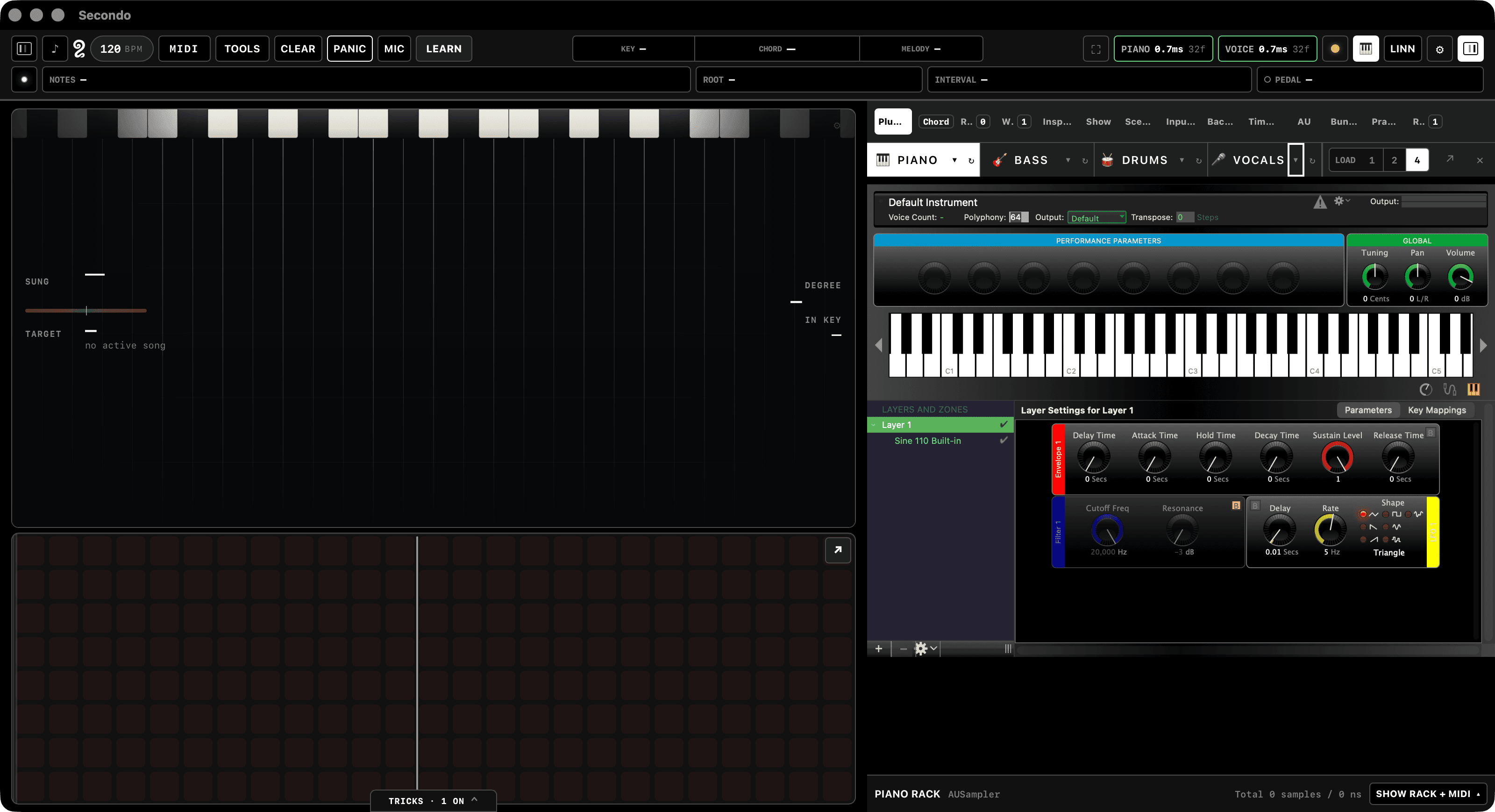
Your Audio Units, hosted
Secondo loads the instruments and effects you already own and opens their real editors inside the app. It ships no sounds of its own and does no processing of its own — the signal path is your plugins.
A rack per role, plus a master
Chain effects on any role, bypass a slot without unloading it, and put a mastering rack across the whole output.
One mixer for the band
Channel strips for every role with pan, gain, mute, solo and live meters. It reads like a mixer because at 9pm you need it to.
Patches you can recall by name
Capture an instrument's entire state as a named snapshot and pull it back on any song.
Nine things that happen between the key and the sound.
All nine live in the Rust engine, save with the song, and can be thrown mid-phrase by a foot pedal, a pad, or a button on the controller itself.
Hand Split
Split the keybed by pitch or by hardware zone. Each side gets its own instrument, octave and transpose — and the side is decided from the note you actually played, so a shift can never throw a note across the split.
Auto Sustain
Sustain that follows the music instead of your foot. Secondo hears the chord change and clears the last one, with a cooldown so it doesn't flap mid-arpeggio.
Sustain Retrigger
A note you nominate drives the sustain on a timer you set — the kick-pedal sustain hack, built into the engine instead of bolted on.
Chord Mirror
Re-voice a chord at any interval, from either hand.
Auto Harmonize
Harmony intervals in real time, optionally top note only.
Octave Doubling
Double up or down, one to three octaves.
Root Doubling
The chord root, dropped, on its own safe channel.
Strum
Spread a held chord — speed, direction, velocity-driven.
Velocity Curve
Compress or expand your dynamics, with a floor and a ceiling.
Built around the way a set actually runs.
Setlists that bring the rig with them
Advance a song and Secondo restores the trick settings, the plugins and their presets, the tempo, the key, and the gains — in one move. Play the set through, fix what's wrong, hit Capture, and the song remembers.
A readiness check before you walk on
One surface that answers the only question that matters at 8:59: is this rig actually ready to play this show.
Windows for the rig you actually have
Stage HUD, lyrics, foot view, and a full-screen performance grid — each its own window, for the second screen and the monitor by the drummer.
Feet and pads
Any MIDI pedal becomes a controller, and a mapped pedal is intercepted before the note pipeline, so a pedal press can never accidentally play a note.
One button that stops everything
Panic kills every hanging note, everywhere, immediately. You will use it. That's why it's on the top bar and not in a menu.
Secondo isn't finished.
It's the rig I play on, and it isn't ready for anyone else's yet. Leave an email and you'll hear once — when it is.